Thursday, August 31, 2006
Sesame Street: Family Programming?
In the spirit of classic elementary school readers from the 1950s (think Dick, Jane, and beyond) comes Rusty is a Homosexual, created by linguist Sean Crist.
Although this page intends to parody the mainstream 1950s all-American boy and his dog, it actually isn't a half bad idea. Imagine incorporating such a story in a text to be read in 3rd grade reading group, or a similar plot line on Sesame Street. Is it possible for Elmo to fall in love with a fireman? How about Grover? Or...perhaps more likely...Ernie or Bert??? And what exactly would the neighborhood think about that? How would they process the information?
Sesame Street fans and critics have suspected Ernie and Bert of being a gay couple for years. The Children's Television Workshop, in spite of its liberal face, takes serious offense to people recreating Ernie and Bert as gay lovers in films, comics, or websites. In 2002, CTW sued a website maker and a Sundance film winner for using Ernie and Bert to portray terrorists, homosexuals, and other incarnations of evil.
The situation grew so unpleasant that the Children's Television Workshop had to issue this press release: "Bert and Ernie, who've been on Sesame Street for [25] years, do not portray a gay couple, and there are no plans for them to do so in the future. They are puppets, not humans. Like all the Muppets created for Sesame Street, they were designed to help educate preschoolers. Bert and Ernie are characters who help demonstrate to children that despite their differences, they can be good friends."
If they sued over copyright infringement, CTW would have made a better case. Shame, shame, shame. If Sesame Street can address issues such as death, pregnancy, deafness, people in wheelchairs, and Israeli and Arab Muppets playing together, one or two gay Muppets can't hurt. Heck, maybe Big Bird wants to be a girl.
Although this page intends to parody the mainstream 1950s all-American boy and his dog, it actually isn't a half bad idea. Imagine incorporating such a story in a text to be read in 3rd grade reading group, or a similar plot line on Sesame Street. Is it possible for Elmo to fall in love with a fireman? How about Grover? Or...perhaps more likely...Ernie or Bert??? And what exactly would the neighborhood think about that? How would they process the information?
Sesame Street fans and critics have suspected Ernie and Bert of being a gay couple for years. The Children's Television Workshop, in spite of its liberal face, takes serious offense to people recreating Ernie and Bert as gay lovers in films, comics, or websites. In 2002, CTW sued a website maker and a Sundance film winner for using Ernie and Bert to portray terrorists, homosexuals, and other incarnations of evil.
The situation grew so unpleasant that the Children's Television Workshop had to issue this press release: "Bert and Ernie, who've been on Sesame Street for [25] years, do not portray a gay couple, and there are no plans for them to do so in the future. They are puppets, not humans. Like all the Muppets created for Sesame Street, they were designed to help educate preschoolers. Bert and Ernie are characters who help demonstrate to children that despite their differences, they can be good friends."
If they sued over copyright infringement, CTW would have made a better case. Shame, shame, shame. If Sesame Street can address issues such as death, pregnancy, deafness, people in wheelchairs, and Israeli and Arab Muppets playing together, one or two gay Muppets can't hurt. Heck, maybe Big Bird wants to be a girl.

Wednesday, August 23, 2006
Men in Tights, Women in Armor

Now kids of any age can read Marvel Comics series featuring gay or lesbian superheroes. Editor-in-Chief Joe Quesada announced that he will reverse the controversial policy that stamped a "MAX" rating on such comics, which limit their audience to those over 18 years old.
"We've had more gay and lesbian characters than ever before," Quesada said. "In many ways, the old policy over the last few years just sort of faded away...there is no longer any policy."
Are Marvel Comics worthy of a place in the children's/YA section of your library? Steve Raiteri, librarian at the Greene County Public Library in Xenia, Ohio seems to think so. Visit his page of comic book (aka "graphic novel") selection tools and annotated graphic novel bibliographies put together by other librarians.
How many gay and lesbian superheroes are flying around out there? Todd VerBeek keeps a running count of them on Beek's Books, a site devoted to reviews of graphic novels and traditional comics. Links to transgender/transsexual comic book heroes exist here as well.
Tuesday, August 22, 2006
Califia = California
 The latest news from Advocate.com:
California assembly approves ban on antigay discrimination in schools
In order for the majority of the California assembly to approve of the ban, legislators had to remove the clause which proposed the inclusion of LGBTQ historical and cultural figures in the state history curriculum. I suppose they will have to start at the beginning, as the state of California was named after the mythical "Califia", a black Amazon queen warrior queen who lived on a mythical island west of the Indies, home to gold, free-loving Amazons, and strange beasts. Some historians believe that the story of Califia, published in 1510 by Spanish writer Garcia Ordonez Rodriguez de Montalvo in the book Las Serges des Esplandian, inspired the Spanish to search for gold in the New World.
The California Department of Education maintains a database of recommended reading for K-12. Gertrude Stein and James Baldwin are out, but Walt Whitman and Audre Lorde are in.
L.A. artist Susan Shelton's "Califia"
Find out what other LGBTQ writers are "state approved"--search the California Department of Education's Recommended Literature Search for Reading and Language Arts.
Monday, August 21, 2006
LGBTQ Sports Heroes
Scenario: The shy, bookish boy has a run-in with the school football team in the locker room. He has done nothing except to exist. Perhaps he had just finished with his gym class, perhaps he had just finished with detention--a lap around the track for every day he cut gym. No matter. The football team does not welcome the boy in their territory, and decide to do something about it.
Scenario: A shy, bookish boy is pressured by his father to join the football team, to make "a real man" out of him. The boy reluctantly obeys, much to the chagrin of the football coach. The coach taunts the shy boy as much as his father would. "You throw like a girl," the coach continues to insist. "There's no hope for you. Drama--now that's your thing." The football team does not welcome this boy in their gang, and attempt to drum him out with the coach's unspoken support.
Scenario: A girl wants to join the school football team. She has a great deal of experience playing street football with the neighborhood kids, and they can attest to her talents. She has a good arm, a great tackle, and nothing gets in her way of the touchdown. The girl hears that they cut someone off the team, and jumps at the chance to wear her school colors. Her mother finds out, calls the football coach, and soon there is a school meeting--the coach, the mother, the school psychologist, and the girl.
Why should a butch girl be made to feel ashamed about playing football? Email The National Girls Football Association for more information! And why should a shy effeminate boy be discouraged from competitive sports by his teammates?
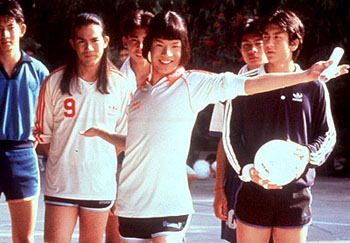
Team members from "The Iron Ladies"
There are gay, lesbian, and transgender sports heroes, all over the world, from many historical eras. And their names should appear in the library and on gymnasium walls for inspiration, and as proof that LGBTQ folks are superlative athletes.
For a crash course in LGBTQ sports heroes, visit Outsports. This site includes news, biographies, and other resources about LGBTQ people in sports around the world.
Did you ever hear about the Gay and Lesbian Athletics Foundation? According to their homepage, GLAF "is dedicated to the acceptance and visibility of gay, lesbian, bisexual and transgender men and women in the professional, amateur, and recreational athletics communities. We also promote positive role models and healthy lifestyles for society at large." Email GLAF and find out what resources they have to offer for children and teens! Read more
It is telling that the most inspirational films about LGBTQ athletes come from abroad. Iron Ladies recreates the true story of a Thai volleyball team composed mainly of gay men, transvestites, and transsexuals, led by a lesbian coach, who win match after match, up to the national tournament.
Another film from Thailand based on fact, Beautiful Boxer traces the steep, rocky path of village boy Parinya Charoenphol, who desperately wants to be a girl. To achieve his goal, as well as to provide financial support for his parents, Parinya trains hard to become a kickboxer.
 Hit it, Martina!
Scenario: A shy, bookish boy is pressured by his father to join the football team, to make "a real man" out of him. The boy reluctantly obeys, much to the chagrin of the football coach. The coach taunts the shy boy as much as his father would. "You throw like a girl," the coach continues to insist. "There's no hope for you. Drama--now that's your thing." The football team does not welcome this boy in their gang, and attempt to drum him out with the coach's unspoken support.
Scenario: A girl wants to join the school football team. She has a great deal of experience playing street football with the neighborhood kids, and they can attest to her talents. She has a good arm, a great tackle, and nothing gets in her way of the touchdown. The girl hears that they cut someone off the team, and jumps at the chance to wear her school colors. Her mother finds out, calls the football coach, and soon there is a school meeting--the coach, the mother, the school psychologist, and the girl.
Why should a butch girl be made to feel ashamed about playing football? Email The National Girls Football Association for more information! And why should a shy effeminate boy be discouraged from competitive sports by his teammates?
Team members from "The Iron Ladies"
There are gay, lesbian, and transgender sports heroes, all over the world, from many historical eras. And their names should appear in the library and on gymnasium walls for inspiration, and as proof that LGBTQ folks are superlative athletes.
For a crash course in LGBTQ sports heroes, visit Outsports. This site includes news, biographies, and other resources about LGBTQ people in sports around the world.
Did you ever hear about the Gay and Lesbian Athletics Foundation? According to their homepage, GLAF "is dedicated to the acceptance and visibility of gay, lesbian, bisexual and transgender men and women in the professional, amateur, and recreational athletics communities. We also promote positive role models and healthy lifestyles for society at large." Email GLAF and find out what resources they have to offer for children and teens! Read more
It is telling that the most inspirational films about LGBTQ athletes come from abroad. Iron Ladies recreates the true story of a Thai volleyball team composed mainly of gay men, transvestites, and transsexuals, led by a lesbian coach, who win match after match, up to the national tournament.
Another film from Thailand based on fact, Beautiful Boxer traces the steep, rocky path of village boy Parinya Charoenphol, who desperately wants to be a girl. To achieve his goal, as well as to provide financial support for his parents, Parinya trains hard to become a kickboxer.
Hit it, Martina!Sunday, August 20, 2006
Do It For Stephen
 (Marguerite) Radclyffe Hall...the real Stephen Gordon?
The Well of Loneliness is one of the first English novels to have a non-traditionally gendered person as the main character. In fact, the character's parents give her the name "Stephen Gordon", because they can see right away that she is not a typical baby girl. As she grows up, Stephen prefers the company of dogs and horses, hates dresses and long hair, and fights with the boys for respect, as well as the attention of other girls. Stephen often finds girls fickle; they often view her as a curiosity, or leave her for men, but her heart does not die. Instead, she becomes as wealthy and as powerful as she can, in the hope that she can gain a woman's heart and loyalty.
Modern critics of The Well of Loneliness often do not put Stephen Gordon in historical context. They forget that Stephen is from an upper class English family, with servants and property. It is not fair for modern critics to expect Stephen to reject her upper class leanings simply because she rejects the traditional gender role of women of turn of the century English culture. For Stephen, an upper class status provided her with the economic freedom and independence to express her true nature, as well as a safety net called "eccentricity".
During the same time period, working class women and wards of the state who wished to follow in Stephen Gordon's footsteps were institutionalized for mental instability. They were subjected to multiple tortures with the goal of turning them "straight", often destroying any sexual desire within them once and for all. In the United States, quite a few women did decide to live as men in order to earn good wages and have their independence. Some of these women had female companions or wives, and their true identities were often not discovered until their deaths. If Stephen Gordon is not "man" enough for you, check out these books for real gender-bending heroes who lived without a safety net:
Katz, Jonathan N.Gay American History: Lesbians and Gay Men in the U.S.A. New York: Plume (Revised Ed.): 1992.
Miller, Neil. Out of the Past: Gay and Lesbian History from 1869 to the Present. New York: Advocate Books: 2005.
Saturday, August 19, 2006
Will Heather's Daughter Have Two Grandmommies?

Leslea Newman's Heather Has Two Mommies will soon celebrate its 20th anniversary. Narrated from a child's point of view, it is one of the first children's books to focus on a "non-traditional" family headed by a lesbian couple. Newman wrote the book because, to her knowledge, no books existed at the time for children of gay or lesbian parents.
Since its publication, Heather Has Two Mommies has caused uproars in schools and libraries across the United States. The book does not only acknowledge that different types of families exist, but it also reveals that women can love each other, live in committed relationships equivalent to marriage, raise healthy, moral children, and become families as ordinary as any other. Heather, the child narrator, tells the audience details about her mommies and her own life with them in a matter of fact way, without disgust, shock, or resentment. Accompanying illustrations show Heather engaged in everyday family activities with her two mommies. For these reasons, Heather Has Two Mommies will always be a classic of children's literature.
A lot has changed since the publication of Heather Has Two Mommies. Vermont, California, Connecticut, New Jersey, and New York now recognize domestic partnerships or civil unions for lesbian and gay couples. Massachusetts, Leslea Newman's home state, now recognizes same-sex marriages. Same-sex couples, with or without children, are gaining visibility in film and television as positive characters, often with fewer marital issues or emotional conflicts than their heterosexual neighbors.
Unfortunately, many lesbian, gay, bisexual, and transgender people in the United States have yet to experience true tolerance in their communities, or their own families. And no same-sex couple in the United States, even one from Massachusetts, is viewed by the federal government as equal to a heterosexual couple. The younger generation of 18-24 year olds, however, has less resistance to same sex marriage, gays and lesbians in the military, or equal rights for LGBTQ people, than their elders. And this is because writers, filmmakers, artists, educators, librarians, and anyone else with the power of story, have worked hard to create visible, positive, and powerful LGBTQ characters for children and young adults.
Many books for children and young adults about same-sex couples, same-sex parents, or lesbian, gay, or transgender characters of any kind, have appeared on the scene, usurping Heather Has Two Mommies as the old stand-by. Modern readers may even find this pioneering work a bit dated, even boring, with its stilted, politically correct language. Perhaps Newman tried too hard to present an average, everyday family, and squeezed all of the life and laughter out of them. How would Rosie O'Donnell react if someone approached her family and remarked, "You all remind me of the Heather Has Two Mommies family"?
And Newman has written much better stuff than Mommies. Her short story "Right Off the Bat", published in her anthologies Secrets and Best Short Stories by Leslea Newman, is a 12 year old girl's story about life with a lesbian mother. Here Newman is not afraid to present a young narrator with the authentic cynical, resentful, honest voice of an almost-teenager who must face the challenge of having a lesbian mother every day at school. As for picture books, Gloria Goes to Gay Pride, in 35 vividly illustrated pages, proves that LGBT folks are active members of one's community, and that they actually laugh and have fun.

